The ShiFt 6-Link Revenue Chain Framework™
A diagnostic model for finding where marketing spend fails to convert into qualified, booked, and attributable revenue.
Of the leads already being generated, where is revenue leaking before it becomes a qualified, booked, and measured opportunity?
From Disconnected Revenue Activity to a Connected Revenue Chain
The Revenue Chain Framework shows how demand becomes booked revenue, and how revenue potential is lost when the system is fragmented. First, the current state: a disconnected chain where value leaks between layers. Then the ShiFt optimized state: a connected operating model where each layer strengthens the next. Finally, the side-by-side comparison makes the transformation clear.
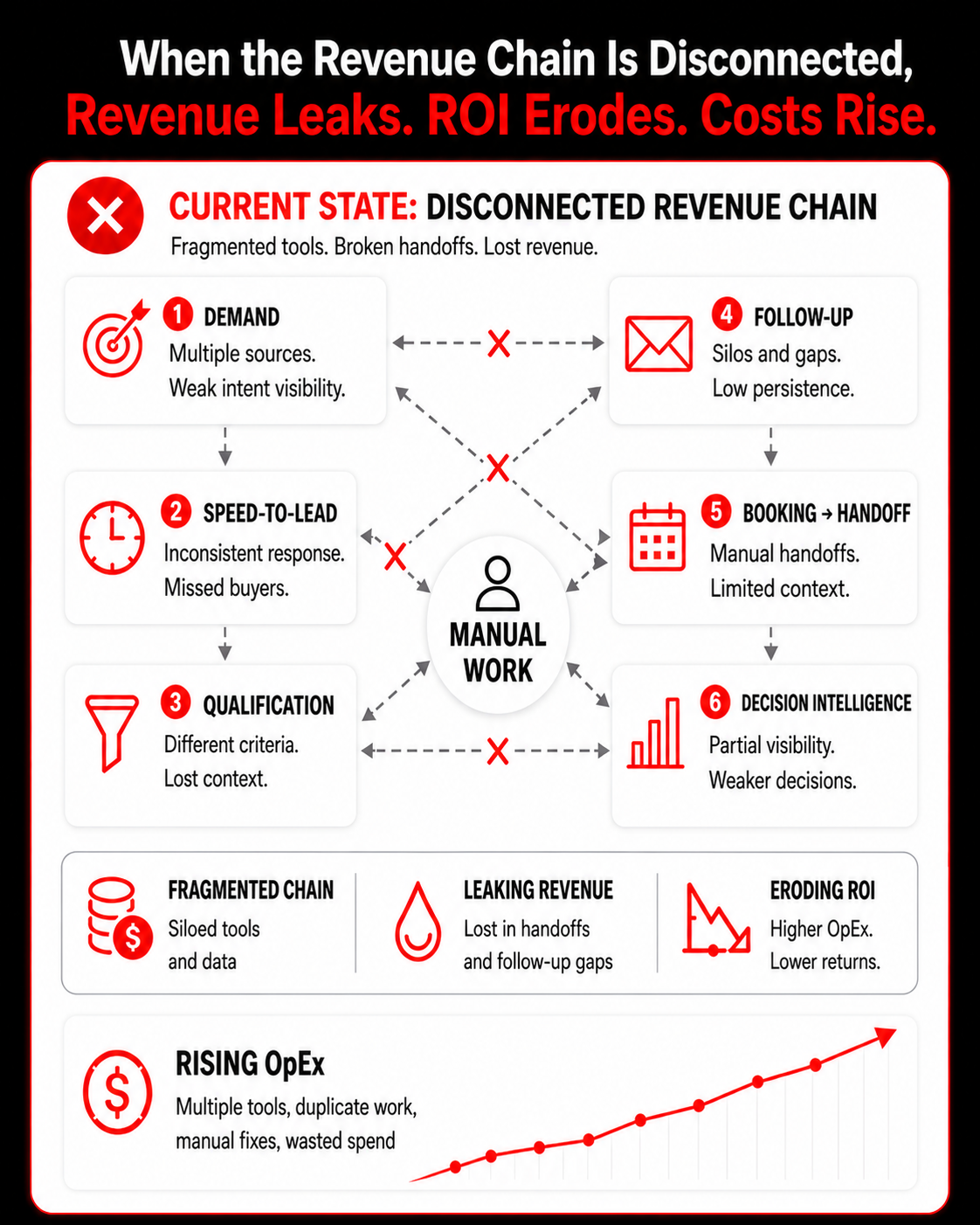
The Disconnected Revenue Chain
Most revenue systems do not fail because one layer is broken.
They fail because each layer operates in isolation. Demand is disconnected from response. Response is disconnected from qualification. Qualification is disconnected from follow-up. Follow-up is disconnected from booking, handoff, attribution, and decision intelligence.
The result is a revenue chain that looks active on the surface, but leaks value between every handoff.
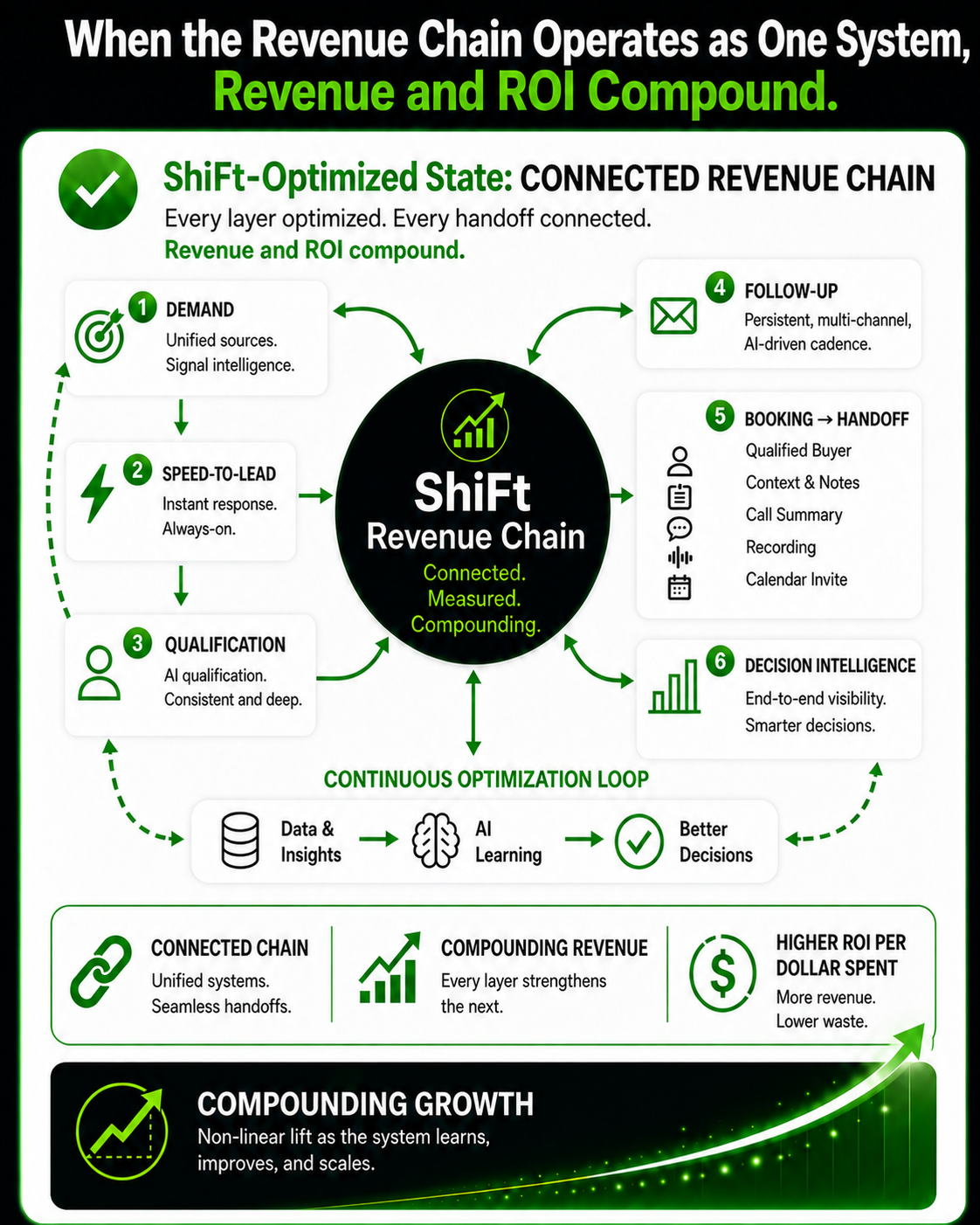
The Connected Revenue Chain
ShiFt connects the revenue chain into one coordinated system.
Instead of treating demand, speed-to-lead, qualification, follow-up, handoff, attribution, and decision intelligence as separate functions, ShiFt aligns them into a continuous operating loop.
Every layer improves the next. Demand becomes signal. Signal drives response. Response supports qualification. Qualification informs follow-up. Follow-up improves handoff. Handoff and attribution create better decision intelligence. The system learns, improves, and compounds.
The transformation is easiest to see side by side. The current state is fragmented: each layer performs work, but the system loses momentum between steps. The ShiFt optimized state is connected: each layer passes intelligence, intent, and context forward so the entire revenue chain compounds instead of leaking.
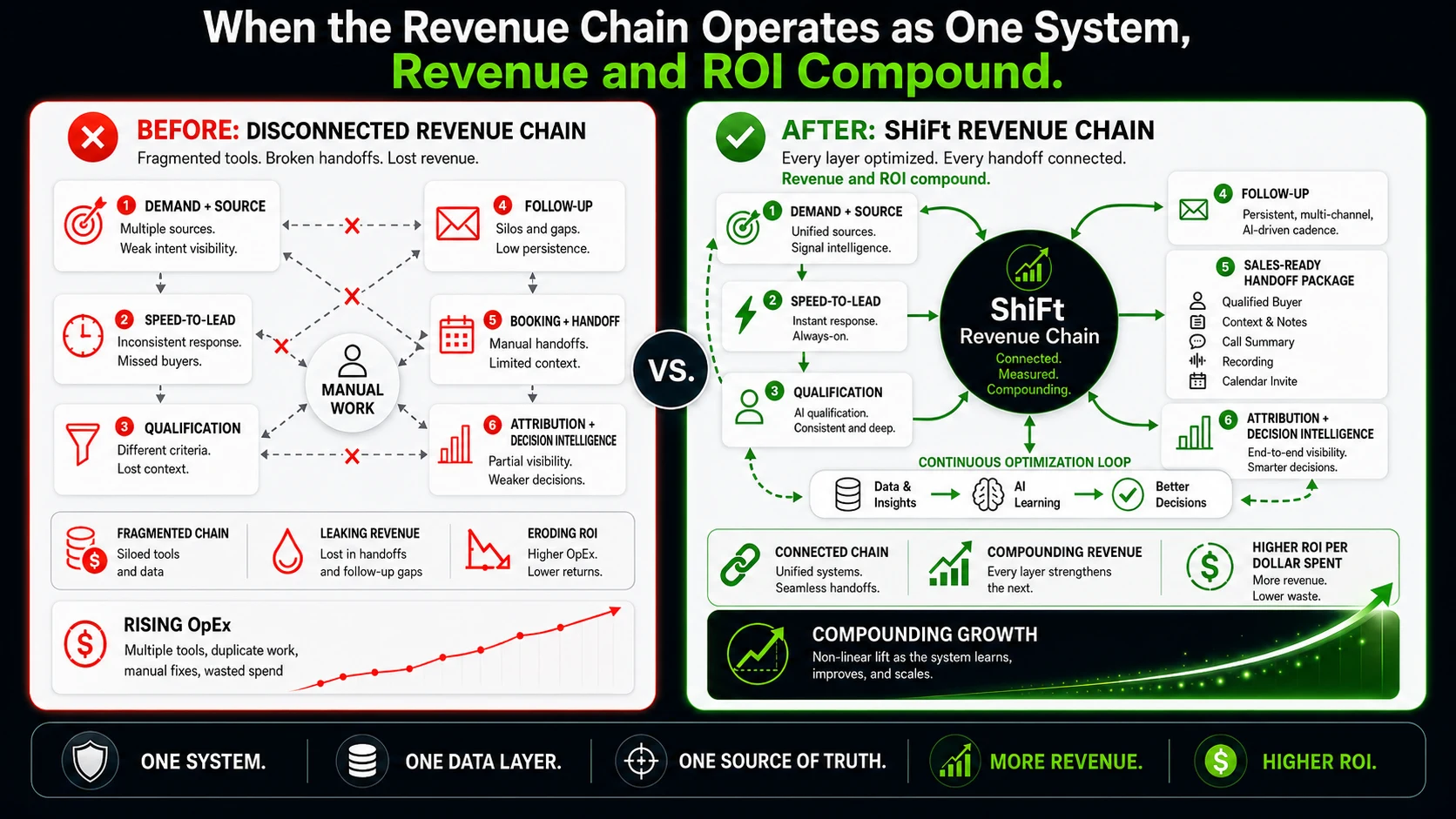
The six links are not six independent functions. Each link passes context, opportunity, and value to the next, and attribution feeds what is learned back into the entire Revenue Chain.
Six links. Six core questions. Six places revenue leaks.
Each link asks one question about the journey from demand to attended opportunity, and each has a signature leak.
Demand
Shows whether the business is generating the right demand, identifying meaningful buyer-intent signals, and knowing which sources create real opportunities, not just cheap leads.
- Identifies Buyers-in-Motion showing real urgency, fit, and active buying signals
- Surfaces Blue Ocean pockets of underserved demand and competitor blind spots
- Prioritizes sources by opportunity quality, not just lead volume
- Feeds cleaner, better-prioritized demand into Speed-to-Lead
Speed-to-Lead
Measures how much demand is lost because the business responds too slowly, or misses the buyer completely.
- Initiates response in seconds when leads come in.
- Removes the delay window competitors use to win the buyer instead
- Protects the opportunities Demand + Source already paid to generate
Qualification
Shows whether good opportunities are identified quickly, or mixed in with poor-fit leads.
- Captures fit, urgency, need, value, and timeline consistently on every conversation
- Routes high-value prospects differently than weak-fit leads
- Passes structured context forward instead of a bare name and number
Follow-Up
Measures how many opportunities disappear because follow-up is weak, late, or dependent on busy humans.
- Persists across calls, texts, and email until a real outcome is reached
- Removes dependence on human memory for follow-up cadence
- Recovers opportunities that would otherwise go cold and silent
Booking → Handoff
Shows whether qualified buyers actually become scheduled appointments, with enough context for sales to win.
- Reduces scheduling friction, confirmation gaps, and no-show risk
- Delivers a sales-ready handoff with qualification details, notes, source data, transcripts, call summaries or recordings, and next actions
- Gives sales what it needs to win the appointment, not just show up to it
Decision Intelligence
Whether source, campaign, opportunity, appointment, and revenue data become real-time intelligence for optimizing what to cut, keep, improve, and scale.
- Connects marketing spend to qualified opportunities, appointments, and revenue
- Turns attribution data into real-time performance intelligence
- Shows which sources, campaigns, and channels actually produce revenue
- Informs where to shift spend toward what is working
- Feeds those insights back into the Revenue Chain so future decisions improve
Link 6 is not the end of the chain. It closes the loop back into Link 1.
Six dimensions per link: not one vague score.
Operational Maturity
How well the process works today.
Operational Severity
How serious the leak appears to be.
Evidence Sufficiency
Whether there is enough proof to support the finding.
Confidence
How strongly the evidence supports the conclusion.
Modeled Recoverable Revenue
Estimated revenue that may be recovered if the leak is fixed.
Action Priority
Which link should be fixed first.
Separating these keeps the diagnosis honest: a severe-looking leak with thin evidence is reported as exactly that, not laundered into a confident number.
Baseline, gap, and effective result.
Each link gets a baseline score, usually 0–100. Then the model asks: how much of the gap to the ShiFt target does the intervention realistically close?
Operational improvement, translated into business value.
Six connected links: one buyer, counted once.
Link impacts must not be blindly added.
The links are connected. The same recovered buyer can be touched by several links on the way to an appointment. Adding each link's full impact would count that buyer multiple times.
ShiFt uses a combined-funnel model, capping total opportunity by realistic limits:
- Total lead volume
- Bookable lead ceiling
- Appointment capacity
- Direct-link contribution weights
- Attribution confidence
What the framework scores, and what it refuses to.
In scopeDemand → attended opportunity
- Lead acquisition quality and prioritization
- Response speed and reliability
- Qualification and routing
- Follow-up persistence and coverage
- Booking, confirmation, and handoff
- Source-to-revenue attribution (for economic modeling)
Not scoredDownstream of the appointment
- Sales rep skill
- Proposal-to-close conversion
- Pricing
- Offer strength
- Fulfillment capacity
- Collections
- Customer success
If the primary problem is downstream of the attended appointment, the framework says so instead of forcing the issue into one of the six links.
What a proper 6-Link assessment produces.
When ShiFt is the right intervention.
The framework identifies where value is leaking. ShiFt connects the response-to-booking process so inbound demand is answered, qualified, followed up, booked, and measured consistently.
The diagram below shows the ShiFt intervention, how the product executes: Answer, Qualify, Book, Own. These are execution steps, not the six Links of the Framework.
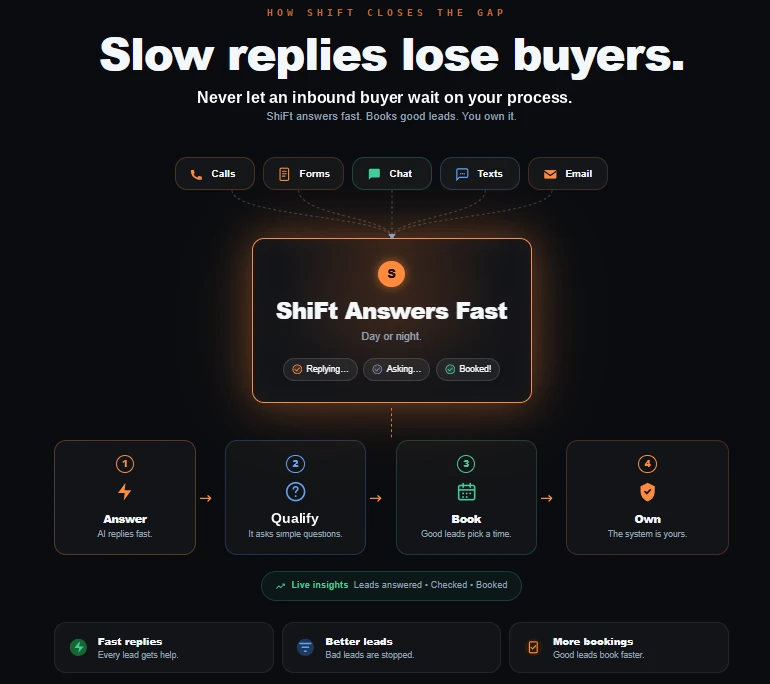
The framework diagnoses the Revenue Chain. ShiFt closes the operational gaps.
Find where your Revenue Chain is leaking.
See how much revenue may be getting lost across the six Links, and which Link represents your biggest opportunity.